
How Long Should a CR2032 Battery Last? - Tiger Head
Finding consumers with a dead car key fob or a non-responsive digital scale often comes down to one tiny component: the CR2032 button cell battery. As manufacturers and procurement specialists in the coin cell industry, we understand that battery longevity is not just a specification—it directly impacts user experience and product reliability.
Whether you are designing low-power electronics or sourcing reliable power cells for mass distribution, knowing how long a 3V lithium coin cell lasts—and why—is essential.
How Long Does a CR2032 Battery Typically Last?
In active devices, a quality CR2032 battery generally lasts anywhere from 2 to 10 years, though actual service life depends heavily on operational drain.
|
Application Type |
Typical Devices |
Expected Lifespan |
|
Ultra-Low Drain |
Computer Motherboard CMOS (BIOS backup) |
5 to 10 Years |
|
Low Drain |
Digital Watches, Calculators, Home Security Sensors |
3 to 5 Years |
|
Moderate/Intermittent Drain |
Car Key Fobs, Fitness Trackers, Kitchen Scales |
1 to 3 Years |
|
High Drain / Continuous |
LED Novelties, Active Bluetooth Beacons |
3 to 12 Months |
How Long Do CR2032 Batteries Last Without Being Used?
Unused CR2032 batteries feature an exceptional shelf life due to their primary Lithium Manganese Dioxide (Li/MnO2) chemistry. Standard unused CR2032 cells last 5 to 10 years in storage while retaining the vast majority of their initial charge.
What Affects CR2032 Battery Lifespan?
Three core variables dictate how quickly a CR2032 cell discharges:
Self-Discharge Rate: Internal chemical degradation occurs naturally over time, even without an active circuit connection.
Operating Load: Continuous micro-amp drains draw far less total capacity than sudden high-peak pulses (such as RF signals from a key fob).
Environmental Exposure: Extreme temperatures and ambient humidity accelerates internal resistance buildup.
What Makes a CR2032 Battery Last Longer?
Maximizing coin cell longevity requires balancing ambient storage factors, circuit design, and chemical manufacturing precision.
Storage Conditions and Temperature
Storage environments dictate shelf retention. Storing batteries in cool, dry areas prevents self-discharge and seal degradation.
Optimal Temperature: Store between 10°C and 25°C (50°F to 77°F). Avoid ambient heat exceeding 30°C.
Humidity Control: Maintain relative humidity below 65% to protect the external stainless steel casing against corrosion.
Original Packaging: Keep cells sealed until deployment to avoid contact with conductive surfaces that cause accidental short circuits.
Device Power Consumption
A device's base current draw determines real-world runtime. Modern low-power microcontrollers benefit from deep-sleep modes, drawing less than 1μA at rest, whereas frequent wireless transmissions shorten active battery operational windows.
Battery Quality and Manufacturing
A cell's integrity relies on manufacturing standards. Multi-layer stainless steel encapsulation, high-purity non-aqueous electrolytes, and precision crimping prevent electrolyte evaporation and internal short circuits over extended operational lifespans.
Which CR2032 Battery Has a Longer Lifespan?
Not all coin cells are engineered equally. When evaluating manufacturing specifications, energy density and structural integrity separate standard batteries from high-performance options.
What to Consider When Comparing CR2032 Batteries?
Nominal Capacity: Standard cells range between 180mAh and 240mAh. Higher nominal milliamp-hours equal longer operating cycles under identical loads.
Leak-Proof Engineering: Multi-layer sealing rings safeguard delicate electronic circuit boards from acidic or corrosive leakage.
Self-Discharge Percentage: Premium cells maintain a self-discharge rate of less than 1% to 2% per year at room temperature.
Tiger Head 3V Lithium Button Cell Battery
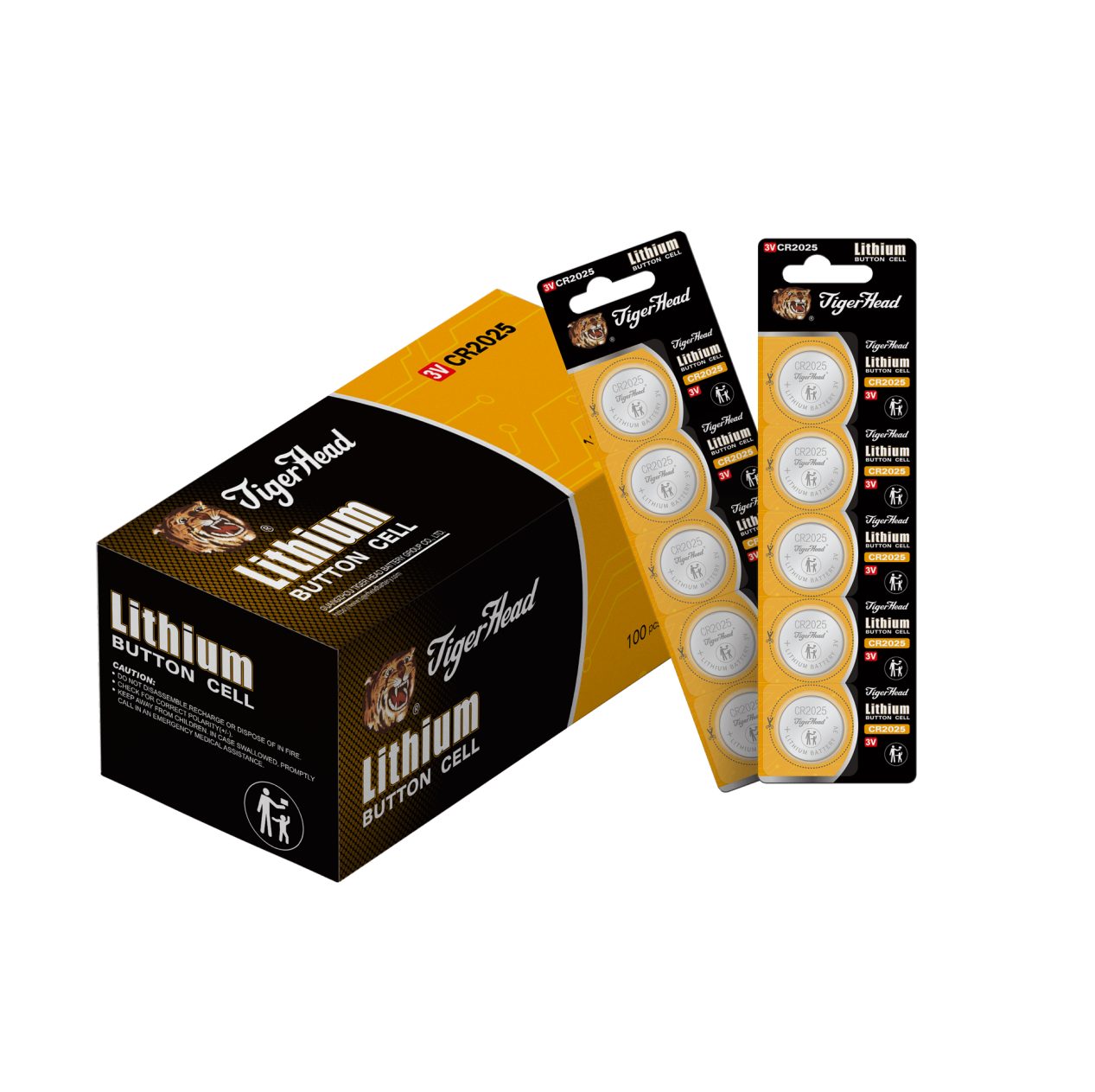
The Tiger Head 3V Lithium Button Cell Battery (CR2032) is designed to deliver high capacity and reliable shelf endurance.
Built with high-energy density Li/MnO2 chemistry and precision pressing processes, Tiger Head CR2032 batteries deliver steady power output for both intermittent key fob usage and long-term CMOS backup systems.
Can a CR2032 Replace a CR2025?
While both batteries share the same standard voltage, substitution depends entirely on physical slot dimensions and contact flexibility.
CR2032 vs CR2025 Size and Capacity
|
Parameter |
CR2032 Battery |
CR2025 Battery |
|
Diameter |
20.0 mm |
20.0 mm |
|
Thickness |
3.2 mm |
2.5 mm |
|
Typical Capacity |
~220mAh – 240mAh |
~150mAh – 170mAh |
|
Primary Use |
CMOS, High-Use Fobs, Scales |
Ultra-Slim Remote Control, Key Fobs |
When Are They Interchangeable?
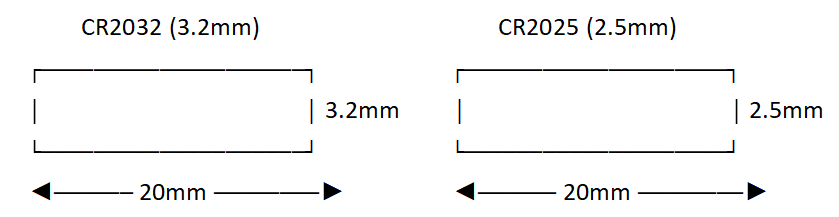
Because the designation numbers describe dimensions—20mm diameter by 32 (3.2mm) or 25 (2.5mm) thickness—both output a nominal 3 Volts.
Replacing CR2025 with CR2032: Only possible if the battery compartment has enough vertical depth to accommodate the extra 0.7mm thickness without forcing the retention spring.
Replacing CR2032 with CR2025: Physical fit is loose; it may require a spacer to ensure electrical contact. However, because a CR2025 has roughly 25% to 30% less capacity, total runtime will be significantly reduced.
FAQs About CR2032 Battery
Q1: Do Batteries Go Bad If You Never Use Them?
A: Yes. Over time, electrolyte breakdown and slow chemical self-discharge cause voltage loss. High-quality cells stored in dry, cool conditions retain over 90% capacity after 5 years, but unbranded cells suffer rapid voltage degradation much sooner.
Q2: Can You Throw a CR2032 Battery in the Garbage?
A: While primary lithium coin cells do not contain mercury, municipal disposal regulations vary. It is best practice to drop used coin cells at designated battery recycling centers. Always tape the positive and negative terminals prior to disposal to prevent accidental short circuits.
Q3: How Can You Tell When a CR2032 Battery Needs Replacing?
1. Voltage Drop: A new cell reads ~3.2V to 3.3V unloaded. When the open-circuit voltage drops below 2.8V, performance degrades rapidly.
2. Reduced Operational Range: Car key fobs require closer proximity to activate door locks.
3. Dimmed Displays: Digital screens on scales or calculators become faint or flicker during high-drain operations.
Selecting high-capacity, leak-resistant button cells ensures your essential electronics remain powered without premature failures. Tiger Head delivers certified 3V lithium solutions engineered for stability, extended shelf life, and long-lasting energy density.


