
How AGM Battery Technology Supports Vehicle Start-Stop Systems
Vehicle start-stop systems are designed to switch the engine off when the vehicle is stationary and restart it when driving resumes. This can reduce unnecessary engine idling, but it also changes the demands placed on the vehicle battery.
The battery may need to support repeated engine restarts, power electrical equipment while the engine is off, and accept charge from the vehicle's charging system within relatively short operating periods.
AGM technology is designed for vehicles that require greater cycling capability and charge acceptance than conventional flooded starting batteries can typically provide. Its Absorbent Glass Mat construction, cycling performance, starting capability, charge acceptance, and sealed design make it suitable for demanding start-stop applications.
However, the correct battery type should always be selected according to the vehicle manufacturer's specifications and battery management system requirements.
Why Start-Stop Vehicles Need a Different Battery
In a vehicle equipped with an automatic start-stop system, the engine may switch off at traffic lights or during other periods when the vehicle is stationary.
While the engine is off, the battery may continue to power electrical equipment such as the radio, lights, windshield wipers, navigation system, climate-control functions, and other electrical consumers.
When the driver releases the brake, presses the accelerator, or the vehicle's control system determines that the engine should restart, the battery may be required to provide starting power again.
As a result, the battery can experience substantially more frequent starting events than a conventional vehicle battery. It also needs to recover the energy used during these events through the vehicle's charging system.
What AGM Battery Technology Means
Absorbent Glass Mat Construction
AGM stands for Absorbent Glass Mat. In an AGM battery, the electrolyte is absorbed and retained within a fiberglass separator positioned between the positive and negative plates.
This differs from the free-liquid electrolyte arrangement commonly used in conventional flooded lead-acid batteries.
The absorbed electrolyte construction helps retain the electrolyte within the battery and supports the battery's sealed design. Tiger Head's technical information also describes the plates as being installed under controlled compression, which helps maintain contact between the plates and the electrolyte.
This construction contributes to the battery's ability to withstand repeated starting and charging cycles while reducing the risk of electrolyte leakage under normal conditions.
How AGM Supports Frequent Engine Restarts
Cycle Capability for Repeated Starts
Start-stop vehicles can subject the battery to frequent charge and discharge cycles. A battery designed for this application therefore needs greater cycling capability than a conventional starting battery.
Tiger Head's H7-80 and H8-95 AGM batteries are specified as having a cycle life of more than three times that of ordinary starting batteries.
This characteristic is relevant to vehicles that repeatedly stop and restart the engine during normal driving.
Starting Power When the Engine Restarts
The battery must also provide sufficient starting current when the engine restarts.
Tiger Head's AGM product information states that the cold cranking performance is 30% higher than that of ordinary flooded batteries. This specification supports strong starting capability, particularly under demanding conditions.
Actual starting performance can still vary depending on the vehicle, ambient temperature, battery condition, engine condition, and charging system.
How AGM Accepts Charge
After an engine restart, the battery needs to recover the energy used during starting and while the engine was switched off.
If the battery cannot accept charge efficiently, repeated start-stop operation may leave less available energy for subsequent starting events.
Tiger Head's H7-80 and H8-95 AGM batteries are described as having strong charge acceptance. Their product information states that they can quickly replenish consumed power and accept energy recovered through the vehicle's charging system, including energy generated during regenerative braking where supported by the vehicle.
Good charge acceptance is particularly relevant to vehicles that frequently switch between charging, discharging, and engine-off operating conditions.
How AGM Supports Electrical Equipment While the Engine Is Off
Switching the engine off does not necessarily switch off the vehicle's electrical systems.
The battery may continue to support the radio, lights, windshield wipers, climate-control functions, navigation, safety systems, and other electrical consumers.
This means that a start-stop battery must provide not only sufficient starting power but also adequate energy support during engine-off periods.
Vehicles with higher electrical loads can place greater demands on the battery while the engine is stopped.
Tiger Head describes its AGM batteries as suitable for advanced start-stop systems, regenerative braking applications, and vehicles with higher electrical loads.
The vehicle's configuration, original battery technology, battery capacity, dimensions, and battery management requirements should always be checked before selecting a replacement battery.
AGM Safety and Maintenance Characteristics
Reduced Risk of Electrolyte Leakage
The AGM separator retains the electrolyte between the plates and helps reduce the possibility of electrolyte movement during normal handling and operation.
Tiger Head states that its AGM batteries can be installed in different positions, including tilted or inverted positions, and that the battery design helps reduce the risk of acid leakage if the battery casing is damaged.
However, installation should always follow the vehicle and battery manufacturer's requirements.
Maintenance-Free Operation
Tiger Head describes the H7-80 and H8-95 as maintenance-free AGM batteries.
Their design is intended to minimize water loss during normal operation, and users do not need to add water as they would with certain conventional serviceable flooded batteries.
Tiger Head also describes low self-discharge characteristics that support storage performance.
AGM and EFB in Start-Stop Applications
AGM is not the only battery technology used in start-stop vehicles. Tiger Head also supplies EFB start-stop batteries.
The two technologies are designed for different application requirements and should be selected according to the vehicle manufacturer's original battery specification.
|
Item |
AGM Start-Stop Battery |
EFB Start-Stop Battery |
|
Electrolyte design |
Electrolyte absorbed in a fiberglass mat |
Enhanced flooded battery design |
|
Typical application |
Advanced start-stop systems and vehicles with higher electrical loads |
Standard and entry-level start-stop applications |
|
Cycling capability |
Designed for demanding cycling applications |
Higher cycling capability than conventional flooded starting batteries |
|
Charge acceptance |
Designed for strong charge acceptance and frequent charging cycles |
Improved charge acceptance compared with conventional flooded batteries |
|
Energy recovery |
Suitable for vehicles using regenerative braking where specified |
Suitable for compatible energy-management systems |
|
Product examples |
H7-80 AGM and H8-95 AGM |
Q-85 EFB |
The replacement battery should match the vehicle's original requirements. A battery should not be selected solely because it has the same external dimensions.
The vehicle's start-stop system, charging strategy, electrical load, battery management system, battery technology, capacity, cold cranking requirements, and physical specifications should all be considered.
Tiger Head AGM Product Examples
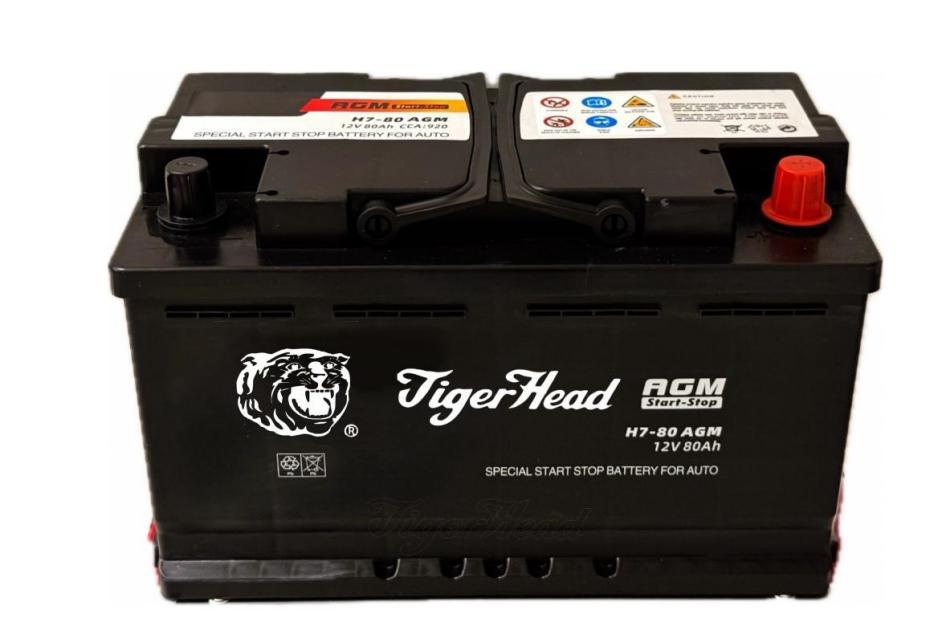
H7-80 AGM Start-Stop Battery
Tiger Head lists the H7-80 AGM for light hybrid and START-STOP vehicle applications, particularly higher-end models.
The official product information lists dimensions of 316 × 176 × 192 × 192 mm and describes the battery as maintenance-free, with extended cycle life, strong cold-starting performance, charge acceptance, and reduced leakage risk.
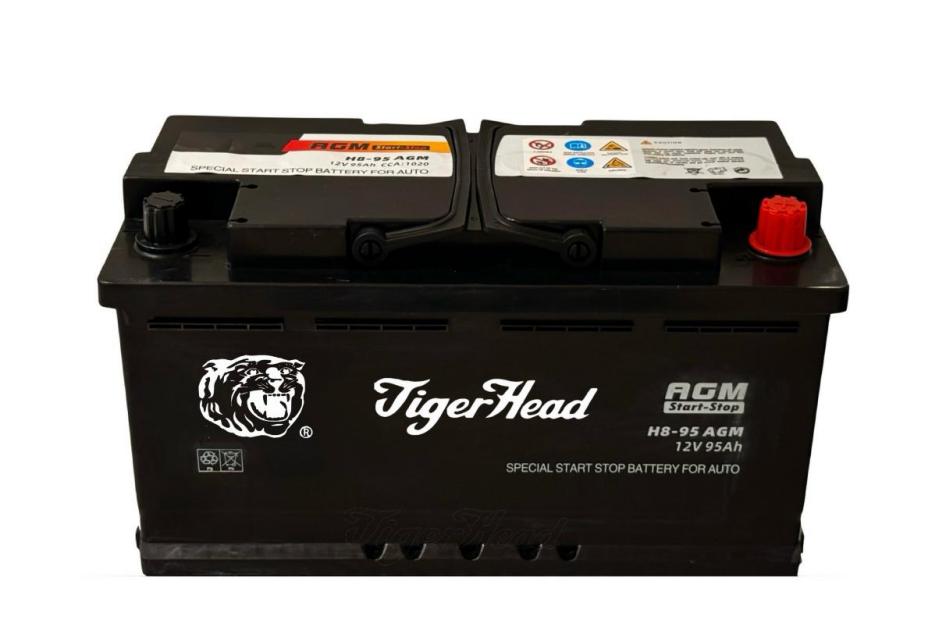
H8-95 AGM Start-Stop Battery
Tiger Head lists the H8-95 AGM for light hybrid and START-STOP vehicle applications, particularly higher-end models.
The official product information lists dimensions of 356 × 173 × 190 × 190 mm and describes the battery as having low self-discharge, extended cycle life, strong starting performance, charge acceptance, and reduced leakage risk.
Conclusion
Start-stop vehicles place greater demands on the battery because the engine may switch off and restart repeatedly while electrical systems continue to operate.
AGM technology is designed to address these conditions through its Absorbent Glass Mat construction, enhanced cycling capability, strong starting performance, charge acceptance, and sealed maintenance-free design.
Tiger Head's product information states that the H7-80 and H8-95 AGM batteries offer a cycle life of more than three times that of ordinary starting batteries and cold cranking performance 30% higher than that of ordinary flooded batteries. Their specifications also emphasize charge acceptance and the ability to accept energy recovered through compatible vehicle charging and regenerative-braking systems.
These characteristics make AGM technology suitable for advanced start-stop systems, selected light-hybrid applications, vehicles with higher electrical loads, and other demanding automotive applications.
The final battery selection should always follow the vehicle manufacturer's requirements, including battery technology, dimensions, capacity, starting performance, electrical specifications, and battery-management-system compatibility.
Tiger Head Battery provides AGM and EFB start-stop battery solutions for different automotive applications and global procurement needs.


